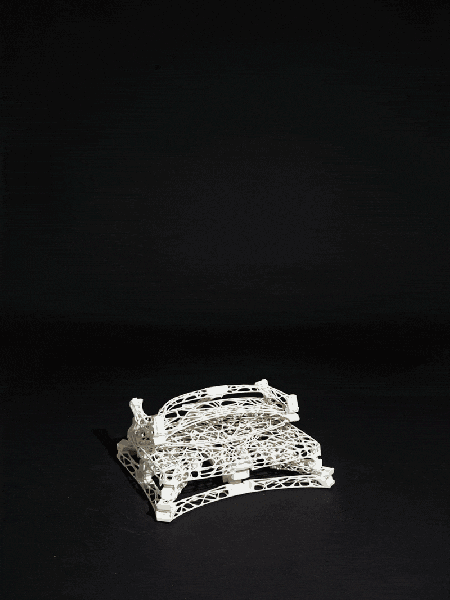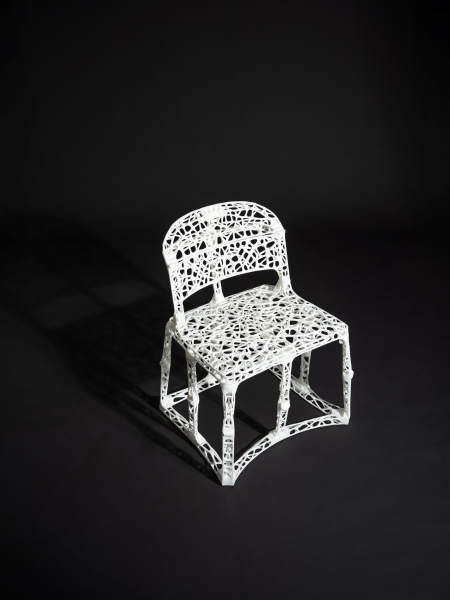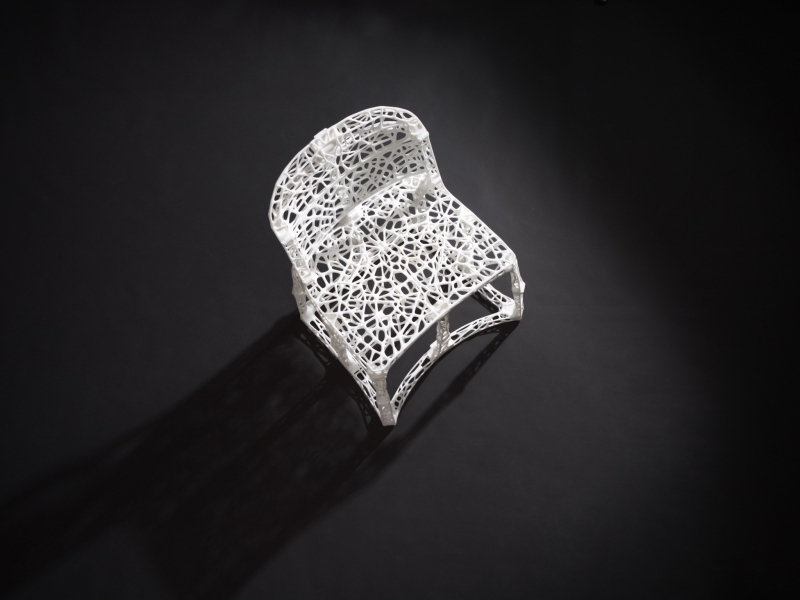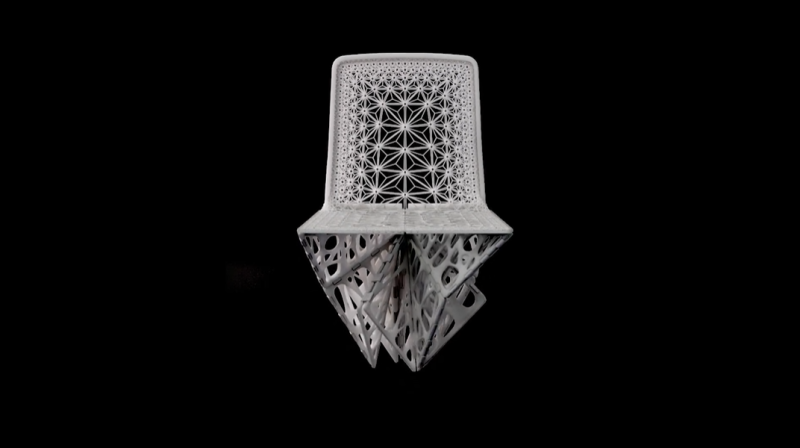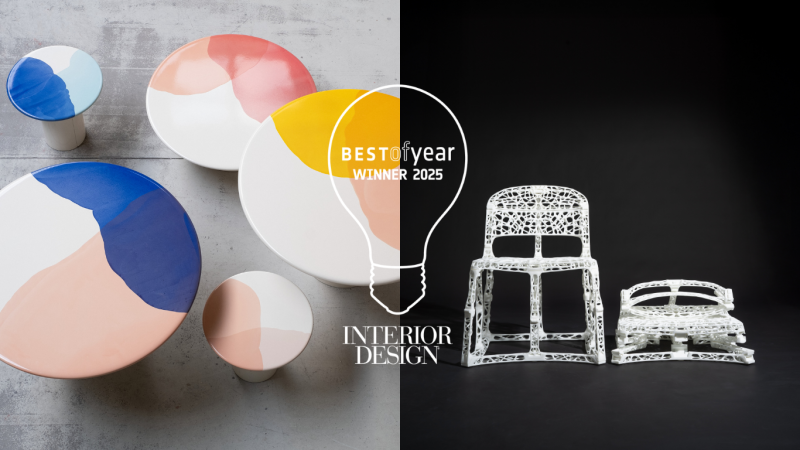
The TA.TAMU chair was not born from a freehand gesture, a line drawn by hand, or even a stylized sketch. It is the result of a calculation. Designed using Catia, Dassault Systèmes' software and its structural topology optimization module, its shape was not decided by the designer, but revealed by mathematical logic: logic that, based on mechanical constraints, determines precisely where material is needed—and where it is not.
The result is surprising: the shape obtained seems organic, almost alive. It evokes a skeleton or a plant branch. Yet it was not “drawn” in the traditional sense of the term. It literally emerged from the constraints, like a bone forming under the effect of the forces acting on it.
Through it, a question emerges:
How can we think aesthetically about a form that is not stylized, but calculated?
A form that embodies material purity, but bears no resemblance to the modernist canons of visual simplicity.
From design to emergence
Simplicity is no longer what it used to be
In the tradition of modernist design, simplicity is visual: straight lines, smooth surfaces, basic shapes. It expresses a desire for universality, rationality, and neutrality. But TA.TAMU shows us another form of simplicity: structural, not visual. It is no longer the designer's hand that simplifies, but the logic of constraints that purifies.
Gilbert Simondon wrote that “form does not precede the object: it is the expression of a becoming.”
TA.TAMU is a form in the making, the result of a process, not a style. It is what Simondon would call a transductive form: a form that is not imposed on matter, but emerges from the tension between matter and information.
From design to emergence
This change in logic transforms the role of the designer. They no longer “impose” a form: they put in place the conditions for a form to appear. Anne Asensio put it this way:
“We have moved from designing the object to designing the conditions for the emergence of the object.” "
Here we find the thinking of Martin Heidegger, for whom a work of art is not a representation of the world, but a way of bringing it into being:
"The work brings forth truth as a revelation. It reveals what is not shown. "
The aesthetics of life
Computational intelligence as a partner
TA.TAMU follows this logic: it reveals a form that is not immediately apparent, an aesthetic of the bare essentials. The object is not decorative. It is a consequence.
The aesthetics of life
This beauty is not ornamental. It follows the logic of life: economy, adaptation, efficiency. Like a shell, a branch, a wing, TA.TAMU is beautiful because it is “right.” It does not seek to seduce; it expresses an internal balance, a profound harmony between forces and matter.
John Dewey, in Art as Experience, wrote that “beauty is the organization of means towards an end that is immanent in those means.”
This is exactly what is at work here: an immanent aesthetic, without an external model, without a decorative project. A beauty that is discovered, not dictated.
Computational intelligence as a partner
In this process, software is not a passive tool. It becomes a partner to the designer, a co-author. The philosopher Vilém Flusser, in A Short Philosophy of Design, already sensed this:
“The designer of the future will no longer draw, he will program. And beauty will no longer be the quality of a form, but that of a process.” "
TA.TAMU illustrates this transition. It is not a formal signature, but a process of co-emergence between human intuition and computational logic.
Towards an aesthetic of necessity
TA.TAMU is not a definitive object, but a step along the way. It charts a path towards a post-stylization, post-industrial aesthetic that is attentive to the urgent issues of our time—resource scarcity, environmental responsibility, and a new alliance between humanity and machines.
Bruno Latour invites us to think about a world where objects are agents, where design is a constant negotiation with constraints:
“What we call objects are in fact proposals. And every proposal is subject to change.” "
TA.TAMU is a proposal. Not a single answer, but the opening of a field.
A way of seeing differently. Of finding beauty not in what we impose on matter, but in what we discover by letting it speak.
In this sense, human intervention is not limited to validating or launching simulations: it interprets, judges, and chooses from a range of possibilities resulting from calculation. This is not an abandonment of form, but a redefinition of its development: the designer becomes the curator of generated forms, the one who gives coherence, relevance, and legibility to what could have remained purely mathematical.
This dialogue reveals a paradox: although dictated by mechanical constraints, the “just necessary” forms proposed by the software bore a certain resemblance to each other. A formal convergence appeared, as if the optimization itself were drawing a style—a signature without stylistic intention. This aesthetic of convergence raises questions: does the structure itself possess a visual grammar? Or is it the human eye that, even in calculation, recognizes a familiar beauty?
Contrary to the idea of fully automated generation, the TA.TAMU creation process was never a simple delegation to the software. At each stage, there was an active dialogue with the tool. The designer made choices, adjusted parameters, selected from among the proposed shapes, and sometimes even discarded the most effective ones in favor of those that were more legible, more expressive, or more consistent with the gestures of use.
A dialogue with the machine, not a delegation
The future of design may lie here: in this ability to bring out a beauty that is not drawn, but necessary.
This dialogue reveals a paradox: although dictated by mechanical constraints, the “just necessary” forms proposed by the software bore a certain resemblance to each other. A formal convergence appeared, as if the optimization itself were drawing a style—a signature without stylistic intention. This aesthetic of convergence raises questions: does the structure itself possess a visual grammar? Or is it the human eye that, even in calculation, recognizes a familiar beauty?
Contrary to the idea of fully automated generation, the TA.TAMU creation process was never a simple delegation to the software. At each stage, there was an active dialogue with the tool. The designer made choices, adjusted parameters, selected from among the proposed shapes, and sometimes even discarded the most effective ones in favor of those that were more legible, more expressive, or more consistent with the gestures of use.
A dialogue with the machine, not a delegation
The future of design may lie here: in this ability to bring out a beauty that is not drawn, but necessary.